
Image Masking Explained: When to Use It Instead of Clipping Path

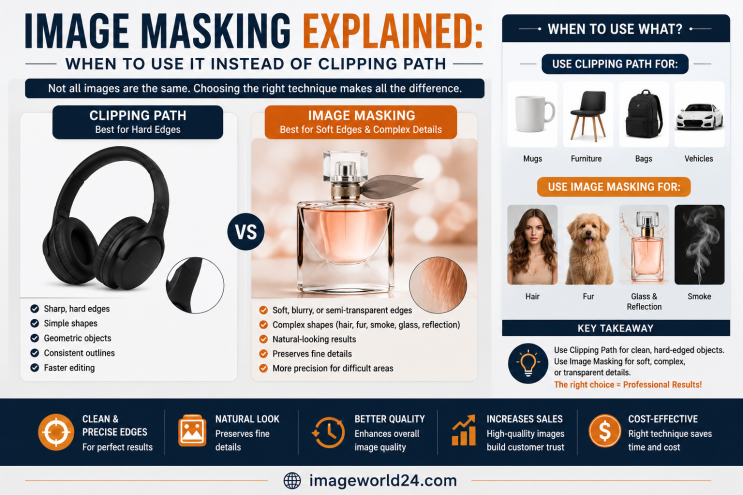
Image Masking is an advanced Photoshop technique used to separate complex objects from their backgrounds while preserving fine details that cannot be accurately cut out with a clipping path.
Instead of creating a hard vector outline, masking uses pixel-based selections that maintain soft edges and transparent areas.
This allows editors to preserve details such as:
The result is a natural-looking image with smooth and realistic edges.
A Clipping Path is a manual editing technique created using the Photoshop Pen Tool.
Editors draw a precise vector path around an object to separate it from the background.
Clipping paths work exceptionally well for products that have:
Examples include:
Because the edges are well-defined, clipping paths produce clean and accurate cut-outs.
Although both techniques remove backgrounds, they are designed for different types of images.
| Feature | Image Masking | Clipping Path |
|---|---|---|
| Best For | Soft and complex edges | Hard and defined edges |
| Hair | ✔ Excellent | ✖ Not suitable |
| Fur | ✔ Excellent | ✖ Difficult |
| Transparent Objects | ✔ Excellent | ✖ Limited |
| Glass Products | ✔ Excellent | ✔ Sometimes |
| Product Photography | ✔ Complex products | ✔ Standard products |
| Editing Method | Pixel-based | Vector path |
| Precision | Excellent for details | Excellent for clean edges |
| Photoshop Tool | Masks & Channels | Pen Tool |
Image Masking is the ideal choice when a clipping path would remove important details or create unnatural edges.
Use Image Masking for:
Individual hair strands are impossible to cut accurately using a clipping path.
Masking preserves every strand naturally.
Animal fur contains thousands of tiny fibers.
Image masking maintains realistic textures while removing the background.
Items such as:
require masking to preserve transparency and reflections.
Wedding dresses, curtains, scarves, and delicate fabrics often contain intricate patterns.
Masking keeps these details intact.
Soft elements such as smoke, steam, and flames cannot be isolated using clipping paths.
Image masking produces much more natural results.
Outdoor photography often requires preserving thousands of small leaves and branches.
Masking allows these details to remain sharp and realistic.
Clipping Path is the preferred choice for products with simple, well-defined shapes.
Ideal examples include:
These objects have clean edges that can be accurately traced using the Pen Tool.
Professional editors use different masking techniques depending on the image.
The most common masking technique.
Used for:
Ideal for preserving transparency and fine details.
Often used for:
Perfect for soft edges and detailed selections.
Commonly used for portraits and fashion photography.
Maintains transparent areas while removing unwanted backgrounds.
Best suited for:
Professional Image Masking offers several advantages.
Maintains tiny details that clipping paths cannot capture.
Soft edges blend seamlessly with new backgrounds.
High-end advertising requires flawless image quality.
Masking delivers premium results suitable for magazines, brochures, and digital campaigns.
Image masking makes it easy to create composite images, promotional graphics, and marketing materials.
Professional masking helps products look clean, realistic, and visually appealing.
Many beginners make these mistakes:
These mistakes can make edited images appear artificial.
Yes.
Professional Photoshop editors frequently combine both techniques.
For example:
This hybrid workflow delivers the highest-quality results for commercial photography.
Image masking is widely used in:
Professional masking requires skill, patience, and attention to detail.
Outsourcing offers:
This helps businesses save time while maintaining premium image quality.
At ImageWorld24, we specialize in high-quality manual image editing services for businesses worldwide.
Our professional services include:
Every image is edited manually by experienced Photoshop professionals to preserve even the smallest details while delivering clean, natural, and professional results.
Whether you need a single image or thousands, we provide fast turnaround, competitive pricing, and consistent quality.
Image Masking and Clipping Path are both essential tools in professional photo editing, but each serves a different purpose.
If your image has clean, hard edges, a Clipping Path is usually the best option. However, when working with hair, fur, transparent materials, lace, glass, smoke, or any subject with delicate details, Image Masking is the superior choice.
Understanding when to use each technique ensures better image quality, stronger brand presentation, and more professional results for eCommerce, advertising, and print.
Image Masking is a Photoshop technique used to remove or replace backgrounds while preserving fine details such as hair, fur, transparent objects, and soft edges.
Neither method is universally better. Clipping Path is ideal for hard-edged objects, while Image Masking is best for complex subjects with soft or transparent edges.
Yes. It is especially useful for products made of glass, plastic, lace, mesh, or other materials that require fine detail preservation.
Professional editors commonly use Layer Masks, Alpha Channels, Refine Edge, and Select & Mask tools, depending on the image.
Professional editors can deliver more accurate, natural, and consistent results while saving you time and ensuring your images are ready for eCommerce, advertising, or print.
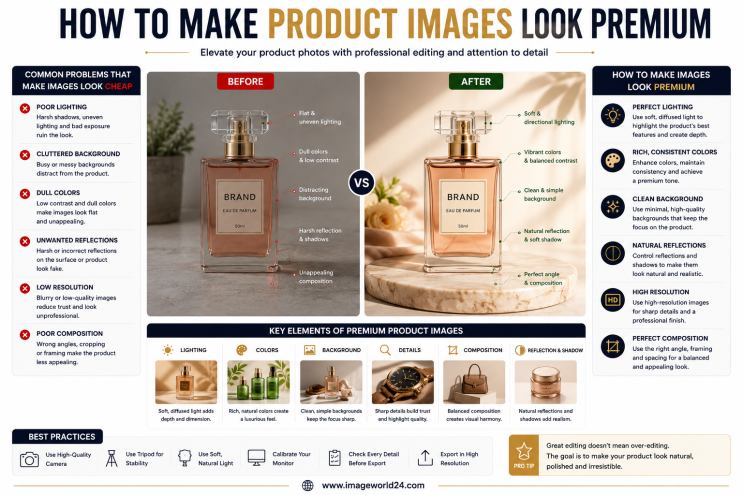
How to Make Product Images Look Premium Premium product images help businesses build trust, attract more customers, and increase online sales. Whether you're selling on Amazon, Shopify, Etsy, eBay, or your own eCommerce website, professional image editing can transform ordinary product photos into luxury-quality visuals. In this guide, you'll learn the best techniques to make product images look premium and stand out in today's competitive online marketplace.
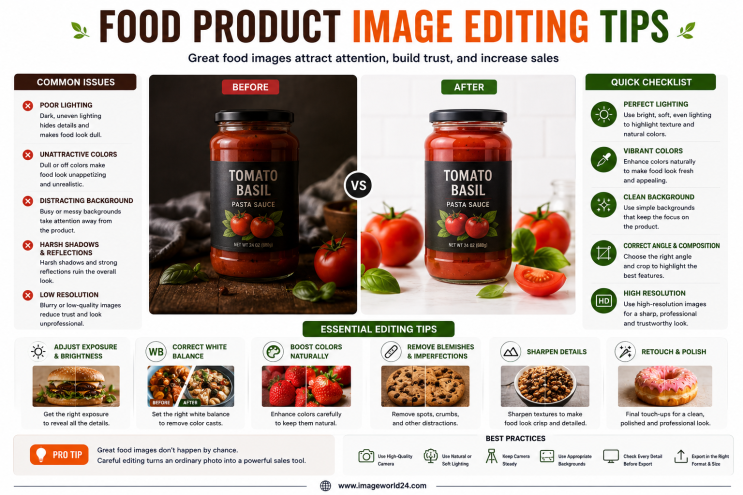
Food Product Image Editing Tips for Better eCommerce Sales High-quality food photography is one of the most effective ways to attract customers and increase online sales. However, poor editing can make food look dull, unappetizing, and unrealistic. In this guide, you'll discover professional food product image editing tips that help restaurants, food brands, grocery stores, and eCommerce businesses create mouth-watering product images that convert visitors into customers.
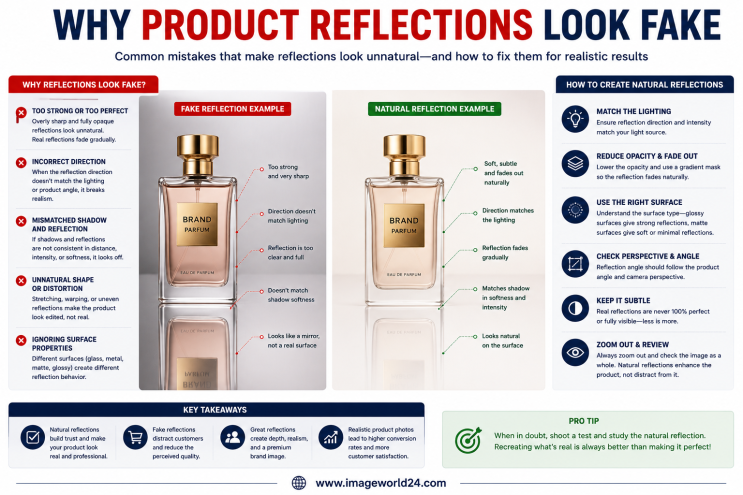
Why Product Reflections Look Fake (And How to Fix Them) Product reflection effects can make product photos look premium, but when done incorrectly, they often appear artificial and reduce customer trust. In this guide, you'll learn why product reflections look fake, the most common reflection editing mistakes, and how professional Photoshop retouching creates natural, realistic reflections for high-quality eCommerce product images.

Furniture Background Removal Challenges and Professional Solutions Furniture photography requires precise background removal to showcase products professionally. However, large sizes, intricate edges, shadows, reflections, and complex designs make furniture one of the most difficult product categories to edit. Learn about the biggest furniture background removal challenges and how professional Photoshop editing creates clean, realistic, and marketplace-ready images.
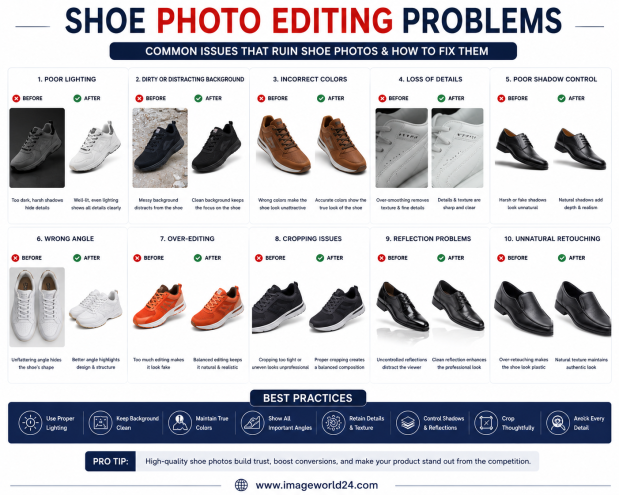
Shoe Photo Editing Problems and How to Fix Them Professional shoe photography is essential for attracting customers and increasing online sales. However, poor editing can make even premium footwear look dull, unrealistic, or low quality. In this guide, we'll explain the most common shoe photo editing problems and how professional Photoshop editing helps create clean, realistic, and high-converting product images for eCommerce.
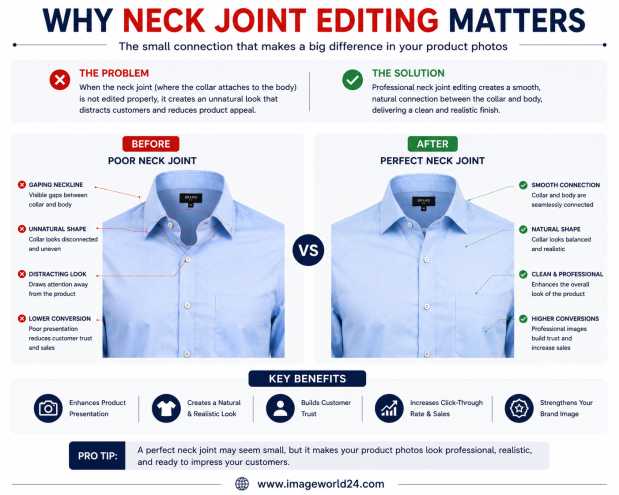
Why Neck Joint Editing Matters for Clothing Product Images Neck Joint Editing is a vital part of Ghost Mannequin photo editing that gives clothing products a realistic, three-dimensional appearance. Without proper neck joint editing, garments can look incomplete, hollow, and unprofessional. Learn why Neck Joint Editing is essential for fashion eCommerce and how it helps improve customer trust and online sales.
ImageWorld24 provides high-quality stock images, professional photo editing, custom visuals, and creative media solutions to help businesses and creators grow with premium visual content.
Call: +8801920933383
Mail: workimageworld24@gmail.com
Location: Dhaka, Bangladesh